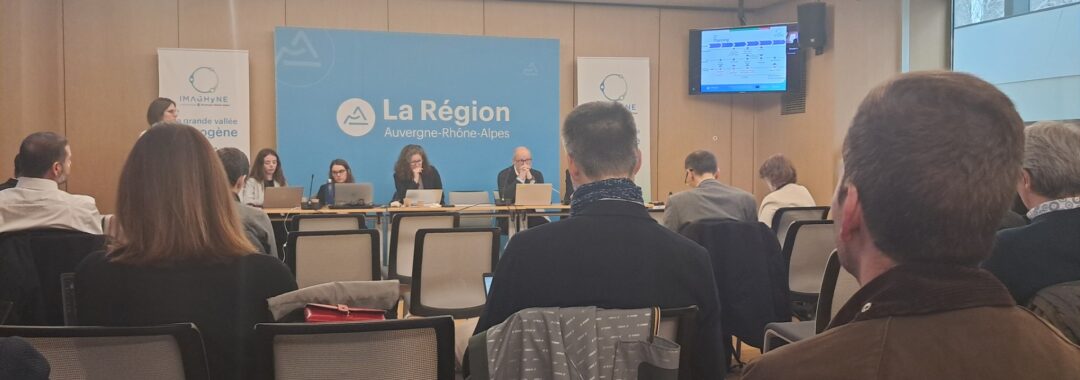
IMAGHyNE project partners during the 4th General Assembly meeting at Hôtel de Région Auvergne-Rhône-Alpes in Lyon, France.

IMAGHyNE sets new strategic roadmap at 4th General Assembly in Lyon

The 4th General Assembly of the IMAGHyNE project took place on December 16th at the Hôtel de Région Auvergne-Rhône-Alpes. This key meeting brought together a consortium of 25 international partners to redefine the strategic trajectory of the Hydrogen Valley initiative following the October 2025 mid-term review.

The assembly focused on a core project restructuring, establishing a collective vision to overcome current sector challenges. Key highlights included the commitment to transparency and the alignment of individual actions with the overarching goals of the Clean Hydrogen Partnership. The roadmap now emphasizes the acceleration of hydrogen adoption across regional territories to maintain the momentum of the European energy transition.

The event concluded with an on-site technical visit to Hyliko’s workshops in St Priest, showcasing innovative solutions for hydrogen-powered heavy-duty vehicles. IMAGHyNE continues to lead the way in creating integrated hydrogen ecosystems, ensuring that clean energy remains a cornerstone of the future European energy mix.

Hydrogen valleys: catalysts for local and global hydrogen economies

A significant trend is emerging in the clean energy sector: the development of «Hydrogen Valleys» and «Hydrogen Hubs.» These integrated hydrogen projects, spanning the entire value chain from production to end-use, have been on the rise since the mid-2010s, signaling a major shift towards hydrogen as a key energy carrier, according to Urban Transitions & Clean Hydrogen Missions on the GUIDEBOOK Clean Hydrogen in cities.

These hydrogen valleys are not just industrial sites; they represent a strategic opportunity for cities to lead the way in the hydrogen economy. Cities are uniquely positioned to act as central hubs where hydrogen production, distribution, and utilization converge, creating dynamic and sustainable ecosystems.

Key steps to developing a hydrogen valley

For cities and regions looking to establish their own hydrogen valley, several key steps have been identified:

  • Strategic partnerships: Engaging with economic development agencies and other key players is crucial for aligning the project with local and regional goals.
  • Resource assessment: A thorough evaluation of local production potential and current/future hydrogen needs is essential for effective planning.
  • Stakeholder engagement: Collaboration with energy utilities, project developers, potential users, and the local community ensures project viability and public acceptance.
  • Financial planning: Securing diverse funding sources, both public and private, is vital for building a strong business case.
  • Integrated planning: A cross-sectoral approach and a comprehensive feasibility study are prerequisites for successful project implementation.

Phased development

Hydrogen valley projects typically unfold in a structured series of phases:

  1. Technical studies: Initial studies lay the groundwork for pilot projects.
  2. Demonstration phase: Testing and experimentation validate technologies under real-world conditions.
  3. Analysis and planning: Economic and environmental assessments inform future development and scaling.

Support and resources

To support the growth of hydrogen valleys, key initiatives and platforms are available:

  • The Mission Innovation Hydrogen Valley Platform serves as a global inventory of hydrogen valleys, providing valuable data and insights.
  • Various funding programs are in place to facilitate the development and deployment of hydrogen valley projects.

This information underscores the pivotal role of hydrogen valleys in fostering the hydrogen economy and provides a roadmap for cities and regions to actively participate in this transformative energy shift.
 

hydrogen-week-hydrogen-valleys-h2-territory

Seven national associations join forces to advance clean hydrogen across Europe

At this year’s European Hydrogen Week (2024), seven prominent national hydrogen associations took a significant step towards advancing clean hydrogen technologies by signing the Cooperation Charter for European Associations Advancing Clean Hydrogen. The Charter, developed by Hydrogen Europe, represents a unified commitment to accelerate the deployment of hydrogen technologies, mitigate investment risks, and foster capacity-building across the continent.

The new signatories—Hydrogen UK, Bulgarian Hydrogen and Fuel Cell Association (BGH2A), Deutscher Wasserstoff-Verband (DWV) e.V., Latvian Hydrogen Association, Lithuanian Hydrogen Energy Association, Romanian Association for Hydrogen Energy (AEHR), and the Czech Hydrogen Technology Platform (HYTEP)—join 23 associations that initiated the charter earlier this year. Together, they aim to shape a sustainable future by promoting policies for hydrogen technologies, supporting the development of clean hydrogen markets, and equipping Europe with the skills needed for a thriving hydrogen economy.

This collaboration underpins Europe’s ambition to achieve carbon neutrality by 2050 and underscores the importance of regional partnerships in driving the transition to a clean energy future.

Read the Cooperation Charter and see all signatories!